The 2026 Dealership SEO Guide
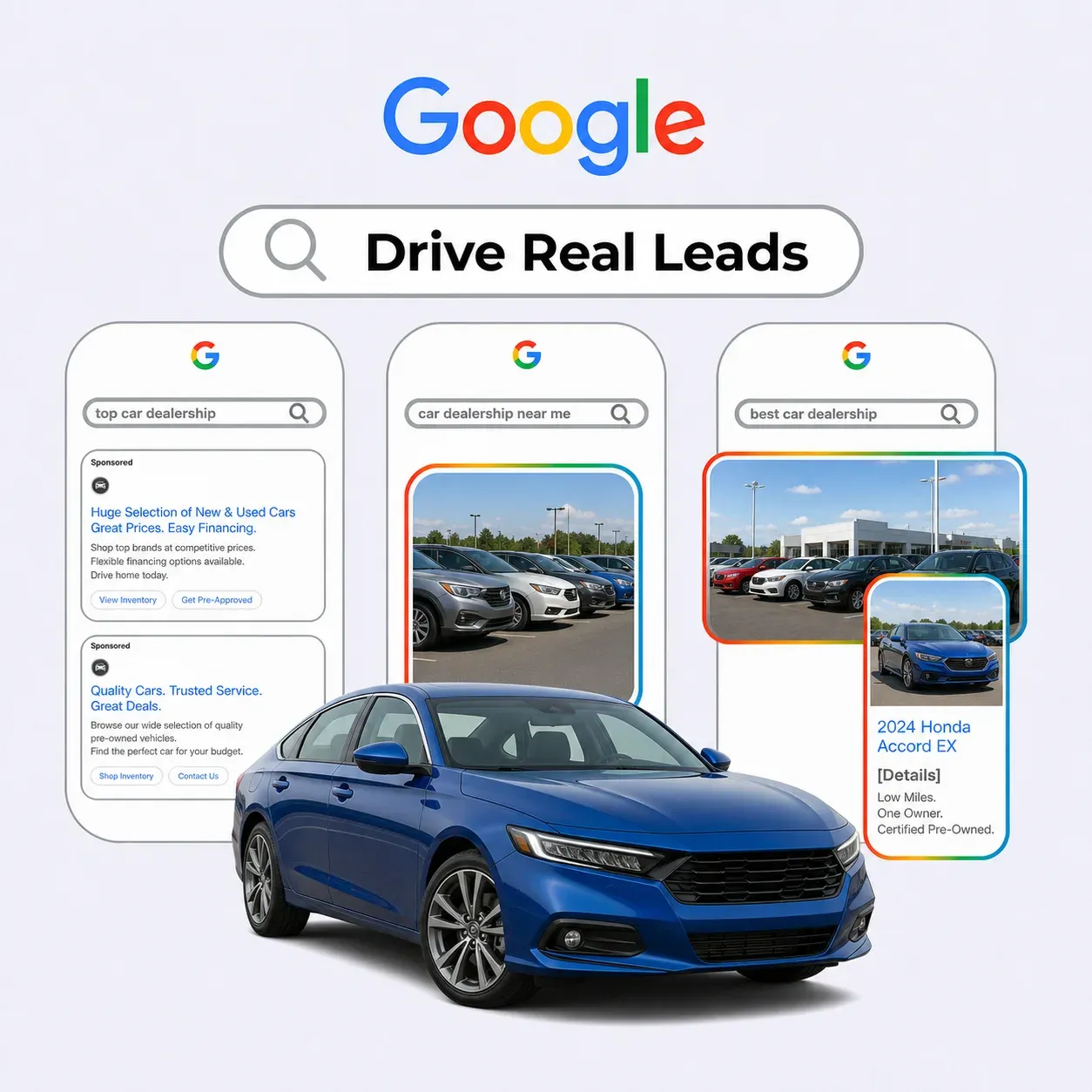
If your dealership isn’t showing up on page one of Google for your make, model, and market, you’re handing leads to your competitors every single day. In 2026, car dealership SEO isn’t optional — it’s the highest-ROI channel most dealers still under-invest in.
This dealership SEO guide walks through the exact framework we use at Dzi Consulting to move dealerships from page three to page one — without spammy tactics, without cookie-cutter templates, and without waiting six months to see traction.
1. Start with vehicle detail page SEO
Most dealer websites treat vehicle detail pages like disposable inventory listings. Google treats them like landing pages, and so should you — a VDP is the page closest to a sale on your entire site, and it’s usually the most neglected from an SEO standpoint.
- Unique H1 with year, make, model, trim, and city
- Vehicle JSON-LD schema with price, mileage, VIN, and availability
- Internal links to your inventory, financing, and location pages
- Compressed, properly sized images with descriptive alt text
The most common failure here isn’t a missing tactic — it’s duplicate content. Dealer platforms frequently generate near-identical title tags and descriptions across hundreds of VDPs, which tells Google none of them deserve to rank. Fixing that alone often moves the needle faster than any single tactic on this list.
2. Nail local SEO for dealerships before anything else
For 90% of dealerships, local search drives more qualified traffic than any other channel. That means your Google Business Profile, NAP consistency across citations, and location pages have to be dialed in before you spend a dollar on backlinks.
The local SEO checklist we run for every new client
- Fully optimized Google Business Profile with weekly posts
- Consistent Name, Address, Phone across 40+ automotive citations
- Dedicated city and service-area pages with unique content
- Review acquisition system that generates 5+ new Google reviews per month
3. Build authority with content buyers actually search
Stop writing blog posts about “the history of your brand.” Buyers are searching for comparisons, financing questions, model-year differences, and “best truck for [use case]” queries. Write for those searches and you’ll pick up rankings your competitors don’t even know exist.
Content is also how most legitimate dealership backlinks happen. Nobody links to a generic “About Us” page — but a genuinely useful comparison guide, a local buying guide, or original data about your market gets picked up by local publications, industry blogs, and community sites. Chasing backlinks directly (directory submissions, paid link placements) rarely moves rankings anymore and can carry real penalty risk; earning them through content buyers actually search for is slower but durable.
4. Avoid the mistakes that quietly cap every dealership’s rankings
A few patterns show up in almost every audit we run:
- Thin or duplicate VDP content — the single most common issue, and the one covered above
- No local SEO foundation — running paid campaigns to a site that doesn’t rank locally is paying to compensate for a gap that should be fixed first
- Chasing backlinks instead of earning them — link-buying schemes are easy to spot and increasingly easy to penalize
- No tracking tied to actual sales — see the next section
Fix the first two before touching anything else on this list. They’re the foundation everything else sits on.
5. Track what actually moves the needle
Rankings alone don’t sell cars. Track calls, form fills, chat leads, and appointment bookings tied back to organic traffic. If your agency is only reporting on “keyword rankings” and “impressions,” you’re being sold a report — not results.
Where to start
Pick one of the five sections above and fix it this month. Dealerships that focus beat dealerships that dabble. And if you’d rather have a partner do it with you, that’s exactly what we do.
Frequently asked
- How long does dealership SEO take to show results?
- Most dealerships see meaningful movement in 60-90 days on lower-competition local terms, with broader ranking gains building over 4-6 months. Anyone promising page-one rankings in two weeks is selling something.
- Do I need a new website to do dealership SEO?
- Usually not. Most of the framework above — VDP structure, local SEO, content — works on your existing site. A rebuild only makes sense if the site itself is the bottleneck, not the strategy.
- What's the difference between dealership SEO and local SEO?
- Local SEO is the subset focused on map pack rankings and "near me" searches. Dealership SEO is broader — it includes local, but also VDP/SRP optimization, content, and technical fixes that affect organic rankings everywhere, not just Maps.
- How many Google reviews does a dealership need to compete?
- There's no magic number, but volume and recency both matter — a steady stream of new reviews beats a large stack of old ones. Aim for at least 5 new reviews a month, consistently.